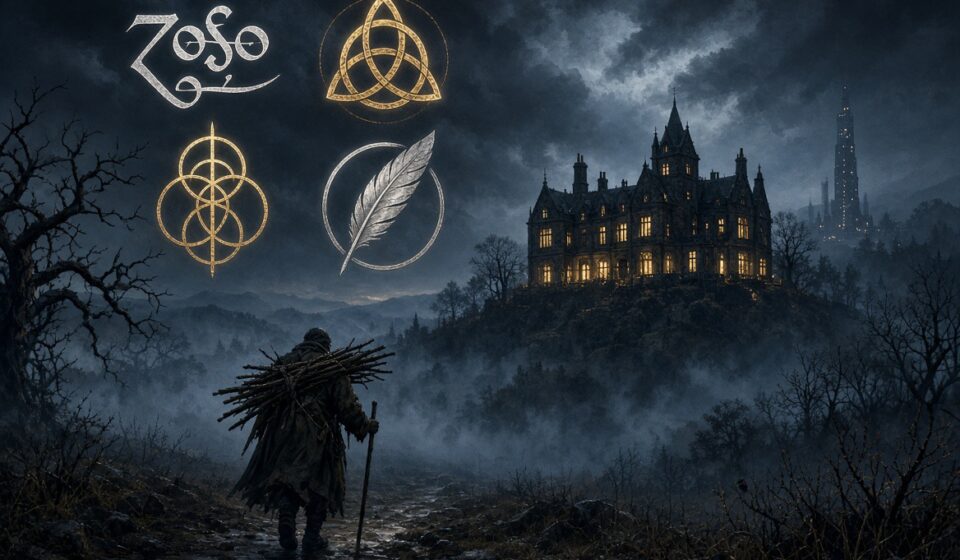

Led Zeppelin IV (officially untitled, also known as Four Symbols, Zoso, or The Runes Album) is the band’s fourth studio album, released on 8 November 1971 by Atlantic Records. It stands as their most commercially successful and culturally iconic release.
Background and Context
After the mixed critical reception of Led Zeppelin III (1970)—which leaned more acoustic and folk—Jimmy Page and the band deliberately stepped back from touring. They wanted complete creative control and a stronger statement. Page pushed for an album with no title or band name on the cover, only four personal symbols, as a response to critics who focused more on the band’s image and commercial success than the music itself.
Early writing took place at the remote Welsh cottage Bron-Yr-Aur (already used for III), where Page and Plant developed ideas including early versions of “Stairway to Heaven,” “Misty Mountain Hop,” and “The Battle of Evermore.”
Recording
Sessions began in December 1970 at Island Studios (Basing Street) in London. The band then moved to Headley Grange, a cold, damp, largely derelict former poorhouse in East Hampshire, for the bulk of the work in January 1971. They lived and recorded there using the Rolling Stones Mobile Studio, engineered primarily by Andy Johns (with assistance from Ian Stewart).
This isolated, communal setup proved decisive. The house’s natural acoustics—especially the large stairwell/hallway—were used to dramatic effect. John Bonham’s drum kit for “When the Levee Breaks” was recorded with microphones placed high in the stairwell, creating one of the most famous (and heavily sampled) drum sounds in rock history. Other tracks captured spontaneous energy: “Rock and Roll” came together in roughly half an hour during a break from struggling with “Four Sticks.”
Overdubs and finishing work returned to Island Studios. An initial mix at Sunset Sound in Los Angeles was rejected as unsatisfactory, so Page and Johns remixed much of the album back in London. The final version was completed by mid-1971, though release was delayed until November to fit the band’s touring schedule.
Cover Art and Symbols
The front cover features a framed photograph of an elderly thatcher (later identified as Lot Long of Mere, Wiltshire) carrying sticks, hung on a crumbling wall. The back shows a modern high-rise (Salisbury Tower in Ladywood, Birmingham) rising behind demolished Victorian terraced houses—creating a deliberate contrast between the old rural world and modern industrial Britain.
Inside, each member chose a personal symbol:
- Jimmy Page – the enigmatic “Zoso” sigil (never fully explained by him; often linked to Saturn/Capricorn).
- John Paul Jones – a circle with three interlocking ovals (from Rudolf Koch’s Book of Signs, representing confidence and competence).
- John Bonham – three interlocking rings (also from Koch; associated with the trinity of man/woman/child, and coincidentally the Ballantine beer logo).
- Robert Plant – a feather in a circle (inspired by the mythical Mu civilization and the Egyptian goddess Ma’at).
Track Listing and Key Songs
- Black Dog
- Rock and Roll
- The Battle of Evermore (featuring Sandy Denny)
- Stairway to Heaven
- Misty Mountain Hop
- Four Sticks
- Going to California
- When the Levee Breaks
“Stairway to Heaven” became the album’s (and the band’s) defining track—never released as a single, yet one of the most played and analyzed songs in rock history. Plant wrote the bulk of the lyrics in a single sitting by the fire at Headley Grange.
Commercial Performance and Reception
The album was an immediate commercial success. It reached No. 1 in the UK and peaked at No. 2 in the US (blocked by Sly & the Family Stone and Carole King). It has sold over 37 million pure copies worldwide (estimates of equivalent album sales exceed 60 million), with 24× Platinum certification in the United States—making it one of the best-selling albums of all time.
Critics at the time were largely positive, and its reputation has only grown. It regularly appears near the top of “greatest albums” lists and is widely regarded as the peak of Led Zeppelin’s classic era, balancing hard rock, blues, folk, and mystical elements more successfully than any other of their records.
Legacy
Led Zeppelin IV cemented the band’s status as the dominant hard-rock force of the early 1970s. Its combination of monumental production, songcraft, and mythic imagery helped define the sound and aesthetic of classic rock. The four symbols remain instantly recognizable, the drum sound of “When the Levee Breaks” is endlessly sampled, and “Stairway to Heaven” continues to be both celebrated and debated more than fifty years later.
The album’s history is inseparable from the physical places that shaped it—especially the cold, echoing rooms of Headley Grange—and from the band’s determination to let the music speak without the usual commercial packaging.